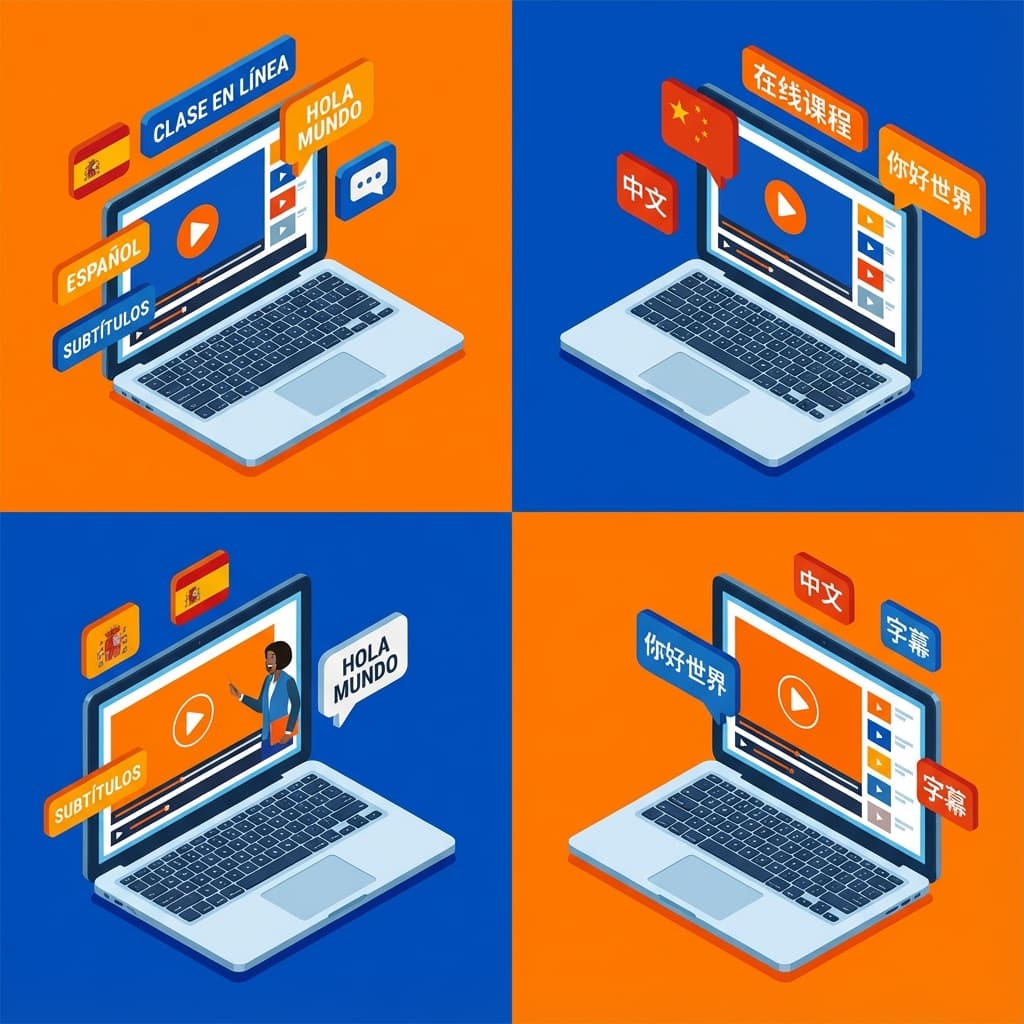
How to Double Your Course Sales by Localizing into Spanish & Chinese
Expand your e-learning business globally. A strategic guide for course creators on using AI dubbing to enter the lucrative Spanish and Chinese markets.
The global e-learning market is booming, projected to reach over $600 billion by 2032. Yet, most course creators are leaving money on the table by creating content exclusively in English. The opportunity is staggering: there are more people learning online in non-English languages than in English, and the gap is widening every year.
While English is the "lingua franca" of the internet, it is the native language of only 5% of the world. By translating your course into high-demand languages like Spanish (500M+ speakers) and Chinese (1.3B+ speakers), you can effectively double or even triple your potential customer base. In this comprehensive guide, we will explore the global e-learning market in detail, provide platform-specific strategies, show you how to price for different markets, and give you a complete workflow for course localization.
Global E-Learning Market: Detailed Breakdown by Region
Understanding where the growth is happening helps you prioritize which languages to target first:
• North America: $150B market, mature and competitive. Dominated by English content. Growth rate: ~8% annually.
• Latin America: $30B market, growing at 25% annually. Severe shortage of quality Spanish-language courses. This is your biggest opportunity.
• China: $80B market, growing at 18% annually. Massive appetite for Western expertise in tech, business, and professional skills.
• Southeast Asia: $15B market, growing at 30% annually. English adoption varies widely. Local language content is increasingly preferred.
• India: $20B market, growing at 22% annually. Hindi and regional languages are essential for reaching the mass market.
• Europe (non-English): $45B market, growing at 12% annually. German, French, and Spanish are the top three languages.
The data is clear: the fastest growth in e-learning is happening in non-English markets, and these markets are dramatically underserved compared to English.
Student Behavior: Spanish-Speaking vs. Chinese-Speaking Markets
Spanish-Speaking Learners
• Preferred format: Video-based courses with practical exercises. Theory-heavy courses underperform.
• Purchasing behavior: Price-sensitive but willing to invest in quality. Installment payment options increase conversion by 40%.
• Peak learning times: Evenings (7-10 PM local time) and weekends.
• Content preferences: Practical skills (coding, digital marketing, design), entrepreneurship, and professional certifications.
• Platform preferences: Udemy, Platzi, Coursera, and Domestika are popular in LATAM.
Chinese-Speaking Learners
• Preferred format: Structured, comprehensive courses. Chinese learners prefer complete curricula over bite-sized modules.
• Purchasing behavior: Willing to pay premium prices for perceived quality. Brand reputation matters enormously.
• Peak learning times: Lunch breaks (12-1 PM) and evenings (8-11 PM CST).
• Content preferences: Technology, finance, English language learning, and MBA-style business courses.
• Platform preferences: Bilibili, NetEase Open Courses, Udemy (global), Coursera. WeChat-based distribution is powerful.
Why Spanish and Chinese?
1. The Spanish Market (LATAM + Spain)
• Size: Over 550 million native speakers across 20+ countries.
• Demand: Huge appetite for professional skills, coding, and digital marketing. Latin America is experiencing a tech boom.
• Competition: Dramatically lower than in English. A localized high-quality course stands out immediately.
• Revenue potential: A well-localized course can generate $2,000-$10,000/month in passive income from LATAM alone.
2. The Chinese Market
• Size: Over 1.4 billion people, with 400+ million active online learners.
• Culture: Education is deeply valued. Chinese families spend an average of 15% of household income on education.
• Opportunity: Western expertise is highly sought after, especially in technology and business. A quality localized course carries prestige.
Platform-Specific Strategies
Udemy
Udemy allows you to upload localized courses as separate listings. This means your Spanish course is a completely new product with its own reviews and rankings. Strategy: Translate your top-performing English course first. Use the Udemy promotional pricing system ($9.99 sales) to gain initial traction in LATAM markets. Target the "Business" and "IT & Software" categories, which have the highest demand in Spanish.
Coursera
Coursera partners with institutions but also offers an instructor marketplace. If you already have a Coursera course, adding Spanish and Chinese versions dramatically increases your reach. Coursera's algorithm surfaces courses in the learner's preferred language, giving translated courses a natural visibility boost.
Teachable / Kajabi
These self-hosted platforms give you complete control. Strategy: Create a separate sales page for each language with fully localized copy, testimonials, and pricing. Use country-specific payment gateways (MercadoPago for LATAM, Alipay/WeChat Pay for China). Consider separate domain or subdomain strategies (e.g., es.yourcourse.com).
Bilibili (for Chinese market)
Bilibili is often called "the YouTube of China." Many course creators upload free preview lessons to Bilibili to build an audience, then direct viewers to their paid platform. AI-dubbed content in Mandarin performs well here because the platform's audience values authenticity and expertise.
Pricing Strategies: Purchasing Power Parity
Charging the same price globally is a common mistake. A $199 course in the US should be priced differently in Mexico and China based on local purchasing power.
| Market | US Price | Suggested Local Price | Reasoning |
| :--- | :--- | :--- | :--- |
| United States | $199 | $199 | Baseline |
| Mexico | $199 | $49-$79 (MXN 850-1,350) | Average income ~25% of US |
| Colombia | $199 | $39-$59 (COP 160K-240K) | Average income ~20% of US |
| Spain | $199 | $129-$159 (EUR 120-145) | Similar purchasing power |
| China | $199 | $79-$129 (CNY 560-920) | Growing middle class, value quality |
Key insight: Lower prices in emerging markets often generate MORE total revenue due to dramatically higher volume. A $49 course in Mexico with 500 students generates more revenue than a $199 course with 50 students in the US.
The Old Way vs. The AI Way
Traditional Dubbing/Subtitling
• Subtitles: Cheap ($1/min) but lower engagement. Students struggle to watch code/slides and read text simultaneously.
• Human Dubbing: Extremely expensive ($20-$50/minute). A 10-hour course would cost $12,000-$30,000 to dub.
AI Voice Cloning & Dubbing
• Cost: Fraction of human dubbing (often <$100 for a whole course with VoiceOver Speech).
• Quality: Use your *own* voice clone, maintaining personal brand authority.
• Speed: Translate a 10-hour course in a single afternoon.
• Updates: When you update a module, re-translate just that section in minutes.
Marketing Localized Courses
SEO for Spanish Markets
• Research Spanish keywords using tools like Ahrefs or SEMrush with the "Mexico" or "Spain" locale.
• Create Spanish landing pages with localized meta titles and descriptions.
• Target long-tail keywords like "curso de python para principiantes" (Python course for beginners).
Social Media Marketing
• LATAM: Instagram, TikTok, and YouTube are dominant. Create short preview clips in Spanish.
• China: WeChat, Xiaohongshu (RED), and Douyin (Chinese TikTok). Partner with local KOLs (Key Opinion Leaders).
Partnerships
Partner with local influencers, bloggers, and educational institutions in your target market. Affiliate programs work exceptionally well in LATAM markets.
Technical Workflow for Course Localization
Step 1: Export Scripts/Captions
Download .SRT or transcript files from your current hosting platform (Teachable, Kajabi, Udemy).
Step 2: AI Dubbing with VoiceOver Speech
1. Clone Your Voice: Upload 1 minute of teaching audio to create your digital twin.
2. Upload & Translate: Upload course videos. Select "Spanish" or "Chinese" as target.
3. Review: AI syncs new audio to video timing automatically.
Step 3: Quality Assurance
• Spot-check 10-15% of translated content for accuracy.
• Pay special attention to technical terminology.
• Have a native speaker review at least the first module.
Step 4: Hosting & Distribution
• Udemy: Upload as a new course listing. This is a separate revenue stream.
• Teachable/Thinkific: Duplicate sales page, translate copy, upload dubbed videos.
Handling Course Updates Across Languages
One of the biggest concerns creators have is: "What happens when I update my course?" With AI dubbing, updating is trivial:
1. Update your English module as usual.
2. Re-upload just the updated section to VoiceOver Speech.
3. Download the new translated audio in minutes.
4. Replace the audio in your localized course.
This process takes minutes, not weeks. No need to re-hire voice actors or translators.
Revenue Projections and Financial Modeling
Here is a realistic projection for a course creator translating their top course into Spanish:
| Metric | English Only | + Spanish | + Chinese |
| :--- | :--- | :--- | :--- |
| Monthly students | 200 | +150 | +100 |
| Average price | $99 | $49 | $79 |
| Monthly revenue | $19,800 | +$7,350 | +$7,900 |
| Annual additional | - | $88,200 | $94,800 |
| Translation cost | - | ~$100 (one-time) | ~$100 (one-time) |
| ROI | - | 882x | 948x |
The ROI on course translation is extraordinary because the cost is minimal (a one-time AI translation fee) while the revenue is recurring.
Student Engagement and Completion Rates in Translated Courses
One of the most compelling reasons to translate your course is the dramatic improvement in student engagement when learners study in their native language. Research consistently shows that students who learn in their first language retain information 25-40% better than those studying in a second language, even when their second-language proficiency is considered "advanced."
Completion rates tell the story clearly. English-only courses marketed globally typically see completion rates of 8-15%. When those same courses are offered in the student's native language, completion rates jump to 20-35%. Higher completion rates translate directly into better reviews, stronger word-of-mouth referrals, and higher lifetime customer value.
Practical tips for maximizing engagement in translated courses:
• Localize examples and references. A case study about Walmart means less to a student in Jakarta than one about Tokopedia. Where possible, swap in locally relevant examples.
• Adjust pacing for cultural expectations. Some cultures prefer more thorough explanations while others favor brevity. Monitor your analytics per language and consider creating slightly adjusted versions.
• Add localized community spaces. Create language-specific discussion forums or Discord channels. Students are far more likely to engage and ask questions when they can do so in their native language.
• Offer localized certificates. A certificate of completion in the student's language adds perceived value and encourages sharing on social media, driving organic referrals.
Case Study: The Coding Bootcamp
An online Python instructor noticed 15% of his traffic came from Mexico but had 0% conversion. He used AI to dub his intro module into Spanish.
• Result: Conversion rate for Mexican visitors jumped to 4%.
• Action: He dubbed the entire course.
• Outcome: Added $4,000/month in passive revenue from the Spanish version within 3 months.
• Year 1 total: The Spanish course generated $48,000 in its first year, from a $100 AI translation investment.
Conclusion
Your knowledge is valuable globally, not just in the Anglosphere. The global e-learning market is growing fastest in non-English markets, and these markets are dramatically underserved. With AI tools like VoiceOver Speech, the barrier to entry has crumbled. The cost is negligible, the process takes hours not months, and the revenue potential is enormous.
Don't let language be the limit of your impact. Start by dubbing your most popular module today.