Neural Speech Synthesis: How Computers Learn to Sound Human
A clear explanation of neural networks behind modern speech synthesis.
Modern text-to-speech (TTS) systems produce voices so natural that many listeners can no longer tell them apart from real humans. Behind that realism lies a remarkable chain of neural network architectures that has evolved rapidly over the past decade. Understanding how these systems work demystifies the technology and helps you make smarter choices when selecting voice solutions for your content.
From Concatenative to Neural TTS
Early speech synthesis relied on concatenative methods: engineers recorded a human speaker saying thousands of individual phonemes and short phrases, then spliced those recordings together at runtime. The results were intelligible but robotic, with audible seams wherever audio segments joined. Prosody — the rise and fall of pitch, the rhythm of speech — was difficult to model because it was essentially stitched from pre-recorded fragments.
Parametric TTS improved on this by modeling the acoustic properties of speech using statistical models such as Hidden Markov Models (HMMs). Rather than storing raw audio, parametric systems stored compact mathematical descriptions of voice features and synthesized waveforms from those parameters. Quality improved, but the characteristic "buzzy" HMM sound remained a recognizable limitation.
The breakthrough came when deep neural networks replaced statistical models. Instead of hand-crafted features, neural networks learn rich representations directly from large corpora of human speech. The result is synthesis that captures the subtle micro-variations in pitch, timing, and timbre that make a voice sound alive.
Spectrograms and Mel-Frequency Representations
A key concept in modern TTS is the spectrogram — a visual representation of how the frequency content of audio changes over time. Raw audio waveforms are difficult to process directly because they contain millions of samples per second. Spectrograms compress this information into a two-dimensional image where the horizontal axis represents time, the vertical axis represents frequency, and pixel brightness represents energy.
Most neural TTS systems work with mel-spectrograms specifically. The mel scale is a perceptual frequency scale that mirrors how the human ear processes sound: it places more resolution at lower frequencies where humans are most sensitive, and less resolution at higher frequencies. By operating in mel-frequency space, models focus computational effort where it matters most for perceived speech quality.
Converting a mel-spectrogram back into an audible waveform requires a vocoder — a module that performs the inverse transformation. Early neural TTS systems used Griffin-Lim, a phase reconstruction algorithm, but modern systems use learned neural vocoders that produce dramatically higher quality output.
WaveNet: The Foundation
DeepMind's WaveNet, introduced in 2016, was the first neural model to produce genuinely human-quality speech. WaveNet is an autoregressive model: it generates one audio sample at a time, with each sample conditioned on all previous samples. The network uses dilated causal convolutions to capture dependencies across long time spans without requiring an impractically deep stack of layers.
WaveNet's output quality was extraordinary, but its autoregressive nature made it slow. Generating one second of audio required millions of sequential computations. Early WaveNet implementations ran far slower than real time, making them impractical for production use. Subsequent work on parallel WaveNet and WaveGlow addressed this bottleneck, enabling real-time and faster-than-real-time synthesis.
Tacotron and the Encoder-Decoder Architecture
Google's Tacotron (2017) and Tacotron 2 (2018) introduced the now-standard two-stage architecture for neural TTS. The first stage is a sequence-to-sequence model with attention: an encoder converts input text into a hidden representation, and an attention-based decoder generates mel-spectrogram frames from that representation. The second stage is a neural vocoder (WaveNet in the original Tacotron 2) that converts the mel-spectrogram into audio.
The attention mechanism is particularly important. It learns to align input text characters with output audio frames automatically, without any manually specified pronunciation dictionaries. This alignment allows the model to handle diverse languages, names, and unusual words far more gracefully than rule-based systems. Tacotron 2 demonstrated that end-to-end training — optimizing both stages jointly on raw text-audio pairs — could produce speech indistinguishable from human recordings in listener tests.
Transformers and VITS
Transformer architectures, originally developed for natural language processing, have since become central to speech synthesis. Transformers use self-attention mechanisms to model relationships between all positions in a sequence simultaneously, enabling faster training and better long-range dependency modeling compared to recurrent networks.
VITS (Variational Inference with adversarial learning for end-to-end Text-to-Speech), introduced in 2021, represents a further advance. VITS is a fully end-to-end model: it generates waveforms directly from text without a separate vocoder stage, using a combination of variational autoencoders and generative adversarial networks. VITS produces extremely natural-sounding speech and supports fine-grained control over speaking style and prosody.
Voice Cloning
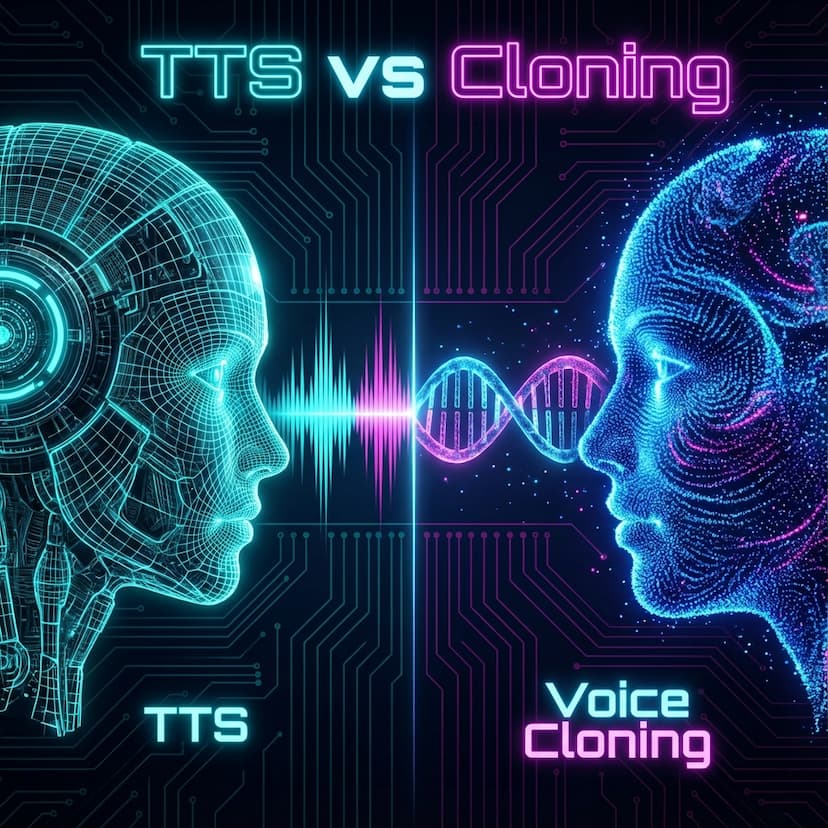
Voice cloning extends neural TTS to reproduce a specific person's voice from a small number of sample recordings. Speaker encoder networks extract a "voice embedding" — a compact numerical fingerprint of vocal characteristics — from reference audio. This embedding is fed into the synthesis model as a conditioning signal, biasing the output toward the target voice's timbre, accent, and speaking style.
Zero-shot voice cloning systems such as YourTTS and Tortoise TTS can clone a voice from as few as three to thirty seconds of audio. Multi-speaker models trained on hundreds of speakers generalize surprisingly well to unseen voices. This technology powers real-time dubbing applications that replace the original speaker's voice with a synthesis that matches their unique vocal identity across languages.
What This Means for Audio Localization
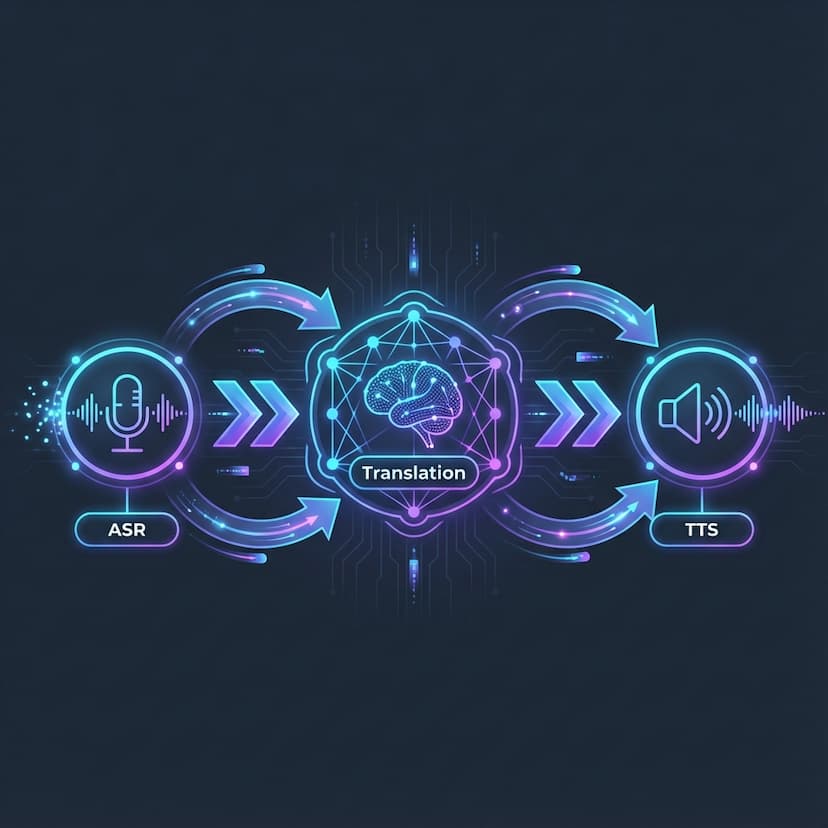
Neural TTS and voice cloning are the engine behind AI-powered dubbing platforms. When you upload a video and request a localized version, these models generate translated speech that preserves not just the words but the emotional tone, pacing, and vocal character of the original. The quality gap between AI dubbing and traditional studio recording has narrowed to the point where AI solutions are now viable for professional content at a fraction of the cost.
Ready to experience neural speech synthesis on your own content? Try the dashboard and generate your first AI-dubbed video in minutes.