Voice Cloning vs. Text-to-Speech: The Technical Differences Explained

A deep dive into spectrograms, neural vocoders, and speaker embeddings. Understand why voice cloning sounds so much more human than traditional TTS.

· 10 min · Technology

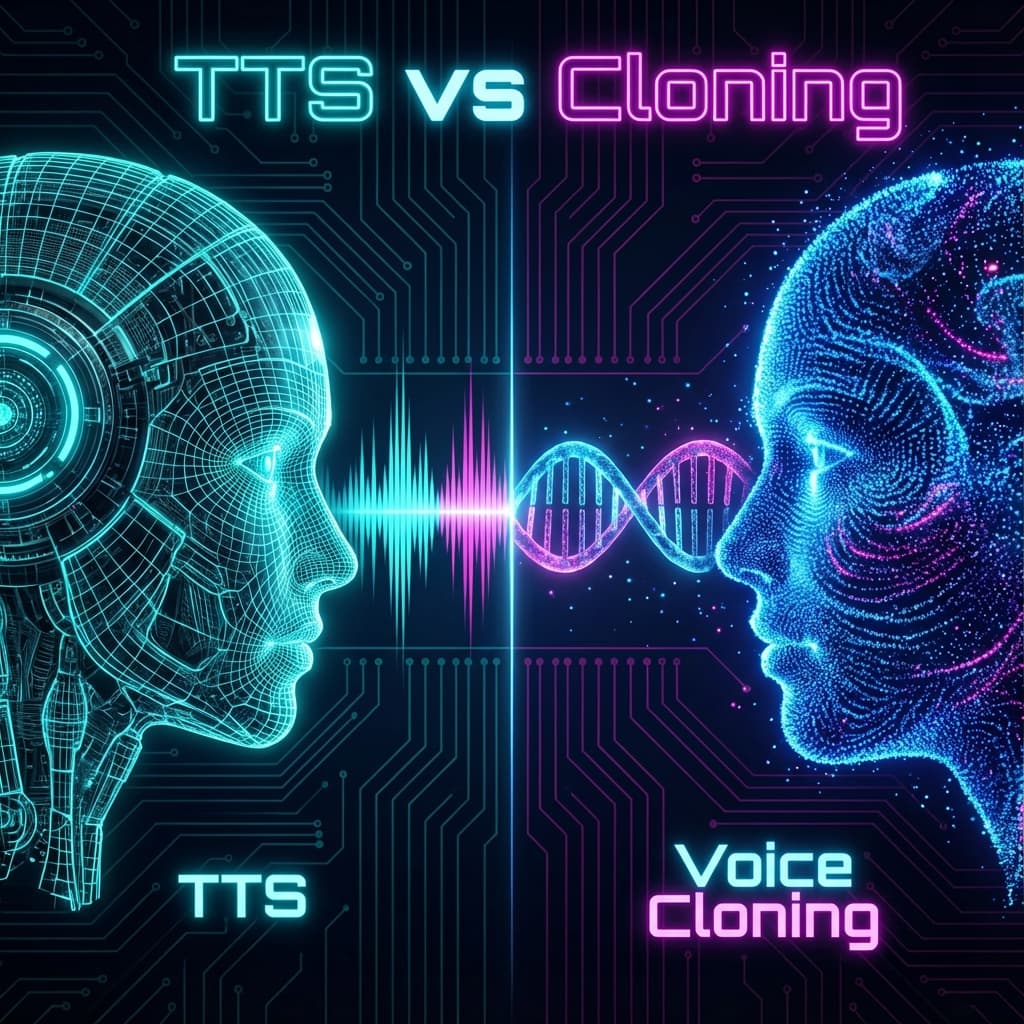
To the average listener, "Text-to-Speech" (TTS) and "Voice Cloning" might seem like the same thing: a computer reading text aloud. But under the hood, they rely on fundamentally different architectures, training paradigms, and design objectives. Confusing these two technologies is like confusing a photocopier with a portrait painter. One reproduces a fixed template; the other captures the essence of an individual.

In this technical deep dive, we will unpack the history, architecture, and future trajectory of both traditional TTS synthesizers and modern Zero-Shot Voice Cloning models. Whether you are an engineer evaluating which approach to integrate into your product, or a creator curious about the technology behind tools like VoiceOver Speech, this guide will give you the clarity you need.

1. Historical Evolution: From Concatenative TTS to Neural Voice Cloning

The journey of speech synthesis spans over six decades, and understanding this history is crucial for appreciating where we are today.

The Concatenative Era (1960s-2010s)

The earliest TTS systems were rule-based, using formant synthesis to generate robotic, mechanical sounds. In the 1990s, concatenative TTS became the dominant paradigm. These systems worked by recording a single speaker for dozens of hours, segmenting their speech into tiny units (diphones, triphones), and then stitching those segments together at runtime. Apple's original Siri voice and early GPS navigation voices were built this way. The result was intelligible but unmistakably artificial, with audible "seams" between concatenated segments.

The Statistical Parametric Era (2010s)

Hidden Markov Models (HMMs) and later Deep Neural Networks (DNNs) replaced raw concatenation with statistical models that predicted acoustic parameters. Instead of gluing waveform fragments together, these systems generated smooth spectral trajectories. The voices sounded less choppy, but they were often described as "muffled" or "over-smoothed" because the statistical averaging process removed the fine-grained details that make human speech lively.

The Neural TTS Revolution (2016-2020)

Google's WaveNet paper in 2016 was a watershed moment. By using autoregressive neural networks to generate audio sample-by-sample, WaveNet produced speech that was nearly indistinguishable from human recordings. However, it was extremely slow and computationally expensive. This led to a wave of faster architectures: Tacotron (Google, 2017) introduced the sequence-to-sequence approach for generating Mel-spectrograms from text, while Tacotron 2 (2018) paired this with a WaveNet vocoder for state-of-the-art quality.

The Voice Cloning Breakthrough (2020-Present)

The true paradigm shift came with models that could generalize across speakers. SV2TTS (Resemblyzer, 2018) demonstrated that a speaker encoder trained on thousands of speakers could extract a compact "voice fingerprint" and use it to condition a Tacotron-like synthesizer. Then came VITS (2021), which combined the acoustic model and vocoder into a single end-to-end model, dramatically improving quality and speed. Most recently, VALL-E (Microsoft, 2023) and its successors showed that treating speech synthesis as a language modeling problem over discrete audio tokens could achieve stunning zero-shot cloning with just 3 seconds of reference audio.

2. The Core Objective: Intelligibility vs. Fidelity

Traditional TTS: The goal is intelligibility. It creates a generic, polished voice (think Siri, Alexa, or Google Assistant) that sounds clear and professional but is devoid of unique character. Every user who interacts with the system hears the same voice. The focus is on pronunciation accuracy, natural prosody, and broad coverage of linguistic phenomena like questions, exclamations, and abbreviations.

Voice Cloning: The goal is fidelity. It aims to replicate the specific timbre, pitch range, speaking rate, accent, breathiness, vocal fry, and other idiosyncratic quirks of a *specific* speaker, often from just a short audio sample. The technology does not just produce "a voice that sounds human," but rather "a voice that sounds like *you*."

This distinction has profound implications. TTS is optimized for average quality across all possible texts. Voice cloning is optimized for speaker similarity on any given text. These are different loss functions, different training strategies, and ultimately different products.

3. The Architecture: A Detailed Technical Comparison

Both systems generally follow a pipeline: Text -> Intermediate Representation -> Waveform. But the details at each stage differ significantly.

Stage 1: Text Processing and Linguistic Analysis

Both TTS and voice cloning systems begin by converting raw text into a linguistic representation. This involves text normalization (expanding "$50" to "fifty dollars"), grapheme-to-phoneme conversion (mapping letters to phonemes using models like G2P), and prosodic analysis (determining stress, rhythm, and intonation patterns). Modern systems often use transformer-based language models to handle this stage, which helps with ambiguity (e.g., "read" can be /riːd/ or /rɛd/ depending on tense).

Stage 2: Text-to-Spectrogram Generation

TTS (Tacotron 2 architecture): An encoder-decoder model with attention maps phonemes to a sequence of Mel-spectrogram frames. The decoder is autoregressive, generating one frame at a time, conditioned on the previous frames and the encoded text. The voice identity is baked into the model weights during training, because the model was trained on data from a single speaker (or a small set of speakers with speaker IDs).

Voice Cloning (VITS / VALL-E architecture): The critical addition is the Speaker Encoder. This is a separate neural network (often based on architectures like GE2E or ECAPA-TDNN) that takes a reference audio clip and produces a fixed-dimensional vector called the Speaker Embedding. This embedding is a compact numerical representation of the voice's identity, capturing information about formant frequencies, spectral envelope shape, pitch range, and speaking style. The speaker embedding is then injected into the spectrogram generator, conditioning every generated frame to match the target speaker's characteristics.

Stage 3: The Neural Vocoder

The vocoder converts the Mel-spectrogram into a raw audio waveform. This is where much of the perceived quality originates.

WaveNet: The original neural vocoder. Autoregressive, generating one audio sample at a time (typically 24,000 samples per second for 24kHz audio). Produces outstanding quality but is far too slow for real-time use without specialized hardware.

WaveRNN / LPCNet: Lightweight alternatives that use recurrent networks with various optimizations to achieve real-time synthesis on CPUs.

HiFi-GAN: A GAN-based vocoder that generates audio in parallel (not sample-by-sample), achieving both high quality and fast inference. This is the most widely used vocoder in modern voice cloning systems, including VoiceOver Speech.

EnCodec / SoundStream: These are neural audio codecs that compress audio into discrete tokens. VALL-E and similar models generate these tokens directly, bypassing the traditional spectrogram stage entirely. This approach treats voice synthesis as a "next token prediction" problem, similar to how GPT generates text.

In voice cloning systems, the vocoder is also conditioned on the speaker embedding, ensuring that fine-grained vocal characteristics like breathiness, vocal fry, and nasality are faithfully reconstructed.

Speaker Embedding Extraction: Step by Step

The speaker encoder is the heart of voice cloning. Here is how the embedding extraction process works in detail:

1. Audio Preprocessing: The reference audio is resampled to a standard rate (typically 16kHz), normalized in volume, and trimmed of silence.

2. Feature Extraction: Mel-spectrogram frames are computed from the preprocessed audio using a Short-Time Fourier Transform (STFT) with standard parameters (e.g., 80 Mel bands, 25ms window, 10ms hop).

3. Encoder Forward Pass: The Mel frames are fed into the speaker encoder network. Common architectures include a stack of LSTM layers followed by a projection layer (GE2E approach) or a ResNet / ECAPA-TDNN convolutional network.

4. Temporal Pooling: Since the reference audio can vary in length, the frame-level outputs are pooled (typically using attention-weighted statistics pooling) into a single fixed-dimensional vector, usually 256 dimensions.

5. L2 Normalization: The embedding is normalized to unit length, placing it on a hypersphere where cosine similarity becomes a simple dot product.

6. Conditioning: This 256-dimensional vector is then broadcast and concatenated or added to the hidden states of the spectrogram generator at every time step, ensuring the generated speech carries the target speaker's identity.

4. Quality Metrics: How We Measure Success

Evaluating speech synthesis requires both objective and subjective metrics:

| Metric | What It Measures | How It Works | Typical Scores | | :--- | :--- | :--- | :--- | | MOS (Mean Opinion Score) | Overall naturalness | Human raters score 1-5 | Human speech: 4.5, Good TTS: 4.0-4.3, Good Clone: 3.8-4.2 | | WER (Word Error Rate) | Intelligibility | ASR transcription accuracy | Good systems: <5% | | Speaker Similarity Score | Voice fidelity | Cosine similarity of embeddings | Good clone: >0.85 | | PESQ / POLQA | Audio quality | Signal-based comparison | Range: 1.0-4.5 | | F0 RMSE | Pitch accuracy | Pitch contour comparison | Lower is better | | RTF (Real-Time Factor) | Speed | Time to generate / audio duration | <1.0 means real-time |

The key insight is that TTS systems optimize primarily for MOS and WER, while voice cloning systems must additionally optimize for Speaker Similarity Score. This is a fundamentally harder multi-objective optimization problem.

5. Real-World Performance Benchmarks

Based on published research and industry benchmarks as of 2025:

Tacotron 2 + HiFi-GAN (single-speaker TTS): MOS 4.2, WER 3.1%, RTF 0.05 on GPU. Excellent quality but limited to the trained voice.

VITS (multi-speaker with cloning): MOS 4.0, Speaker Similarity 0.87, WER 4.2%, RTF 0.08 on GPU. Strong all-around performance.

VALL-E X (cross-lingual zero-shot): MOS 3.8, Speaker Similarity 0.82, supports 7+ languages. Pioneering but still maturing.

VoiceOver Speech Pipeline (Azure-based production system): Leverages Azure Cognitive Services with custom speaker enrollment for high-fidelity cross-lingual dubbing. Optimized for real-world content creation workflows.

6. Data Requirements Comparison

| Feature | Traditional TTS | Few-Shot Cloning | Zero-Shot Cloning | | :--- | :--- | :--- | :--- | | Pre-training Data | 20-50 hours of one speaker | 1000+ hours of many speakers | 60,000+ hours of many speakers | | Target Speaker Data | N/A (voice is fixed) | 5-30 minutes | 3-10 seconds | | Adaptation Method | Full retraining | Fine-tuning for hours | Real-time inference | | Voice Switching | Requires new model | Requires new fine-tune | Just change reference audio | | Quality Ceiling | Very high for trained voice | High | Good and rapidly improving |

7. Use Case Comparison Matrix

| Use Case | Best Approach | Why | | :--- | :--- | :--- | | Virtual Assistant (Alexa, Siri) | High-quality single-speaker TTS | Consistent brand voice, trained extensively | | Audiobook Narration | Voice Cloning (author's voice) | Preserves the author's identity and emotional delivery | | Video Game NPCs | Voice Cloning + Emotion Control | Many unique characters, dynamic dialogue | | Cross-border E-commerce Ads | Zero-Shot Voice Cloning | Rapid localization across 10+ markets | | Podcast Translation | Speaker-preserving Voice Cloning | Maintains host/guest voice identity across languages | | Accessibility (screen readers) | High-quality TTS | Reliability and intelligibility are paramount | | Call Center IVR | TTS with custom voice | Brand consistency, limited variation needed |

8. Cost and Infrastructure Considerations

Building and deploying speech synthesis systems involves significant infrastructure decisions:

GPU Requirements: Training a single-speaker TTS model requires 1-2 GPUs for 2-3 days. Training a multi-speaker voice cloning foundation model requires 8-64 GPUs for 1-4 weeks. Inference for both can run on a single GPU or even a CPU with optimized models.

Cloud vs. Edge: Cloud deployment offers flexibility and easy scaling but introduces latency (50-200ms network round trip). Edge deployment (on-device) eliminates latency but limits model size. Models like VITS can run on mobile devices; VALL-E-scale models currently require cloud GPUs.

Cost per Request: Cloud TTS APIs (Google, Azure, AWS) typically charge $4-16 per million characters. Voice cloning APIs range from $10-50 per million characters due to higher computational cost. Self-hosted solutions require upfront GPU investment but offer lower per-request costs at scale.

Storage: Voice cloning requires storing speaker embeddings (typically <1KB per speaker) and reference audio clips. This is negligible compared to the model weights themselves (500MB - 2GB per model).

9. The Future: Convergence of TTS and Voice Cloning

The boundary between TTS and voice cloning is rapidly blurring. Several trends point toward a convergence:

Universal Voice Models: Future models will likely be trained on massive, diverse datasets and support both high-quality generic voices and zero-shot cloning from a single architecture. Early examples include Microsoft's VALL-E series and Meta's Voicebox.

Controllable Generation: Rather than choosing between "TTS voice A" or "cloned voice B," users will be able to continuously interpolate between voices, adjust speaking style, emotion, pace, and accent independently. This is already emerging in research with disentangled latent spaces.

Multilingual by Default: Next-generation models will handle dozens of languages natively, enabling a speaker to be cloned in English and then speak fluently in Japanese, preserving their vocal identity across languages. This is the core value proposition of VoiceOver Speech.

Real-time Streaming: Advances in model efficiency (distillation, quantization, speculative decoding) are making it possible to generate cloned speech in real-time streams, opening up applications in live translation, gaming, and telepresence.

10. Why "Zero-Shot" Changed Everything

"Zero-Shot" means the model can clone a voice it has never seen during training. Instead of memorizing specific voices, it learns a general mapping from audio characteristics to speaker identity. This is analogous to how a skilled portrait artist can capture anyone's likeness after studying thousands of faces, without having met the subject before.

The implications are transformative. Content creators no longer need to spend hours in a recording studio training a custom voice model. A 5-second sample is enough. This democratizes access to voice cloning technology and makes it practical for use cases that would have been economically infeasible with traditional approaches, from translating a single YouTube video into 10 languages to creating personalized audiobook narrations.

This is precisely why tools like VoiceOver Speech can clone your voice instantly without you needing to record 50 hours of audiobooks first. The technology has reached a point where convenience and quality are no longer at odds, and we are only at the beginning of what is possible.
Technology

Voice Cloning vs. Text-to-Speech: The Technical Differences Explained

2025-06-15
10 min
Voice Cloning vs TTS Technology

To the average listener, "Text-to-Speech" (TTS) and "Voice Cloning" might seem like the same thing: a computer reading text aloud. But under the hood, they rely on fundamentally different architectures, training paradigms, and design objectives. Confusing these two technologies is like confusing a photocopier with a portrait painter. One reproduces a fixed template; the other captures the essence of an individual.

In this technical deep dive, we will unpack the history, architecture, and future trajectory of both traditional TTS synthesizers and modern Zero-Shot Voice Cloning models. Whether you are an engineer evaluating which approach to integrate into your product, or a creator curious about the technology behind tools like VoiceOver Speech, this guide will give you the clarity you need.

ADVERTISEMENT

1. Historical Evolution: From Concatenative TTS to Neural Voice Cloning

The journey of speech synthesis spans over six decades, and understanding this history is crucial for appreciating where we are today.

The Concatenative Era (1960s-2010s)

The earliest TTS systems were rule-based, using formant synthesis to generate robotic, mechanical sounds. In the 1990s, concatenative TTS became the dominant paradigm. These systems worked by recording a single speaker for dozens of hours, segmenting their speech into tiny units (diphones, triphones), and then stitching those segments together at runtime. Apple's original Siri voice and early GPS navigation voices were built this way. The result was intelligible but unmistakably artificial, with audible "seams" between concatenated segments.

The Statistical Parametric Era (2010s)

Hidden Markov Models (HMMs) and later Deep Neural Networks (DNNs) replaced raw concatenation with statistical models that predicted acoustic parameters. Instead of gluing waveform fragments together, these systems generated smooth spectral trajectories. The voices sounded less choppy, but they were often described as "muffled" or "over-smoothed" because the statistical averaging process removed the fine-grained details that make human speech lively.

The Neural TTS Revolution (2016-2020)

Google's WaveNet paper in 2016 was a watershed moment. By using autoregressive neural networks to generate audio sample-by-sample, WaveNet produced speech that was nearly indistinguishable from human recordings. However, it was extremely slow and computationally expensive. This led to a wave of faster architectures: Tacotron (Google, 2017) introduced the sequence-to-sequence approach for generating Mel-spectrograms from text, while Tacotron 2 (2018) paired this with a WaveNet vocoder for state-of-the-art quality.

The Voice Cloning Breakthrough (2020-Present)

The true paradigm shift came with models that could generalize across speakers. SV2TTS (Resemblyzer, 2018) demonstrated that a speaker encoder trained on thousands of speakers could extract a compact "voice fingerprint" and use it to condition a Tacotron-like synthesizer. Then came VITS (2021), which combined the acoustic model and vocoder into a single end-to-end model, dramatically improving quality and speed. Most recently, VALL-E (Microsoft, 2023) and its successors showed that treating speech synthesis as a language modeling problem over discrete audio tokens could achieve stunning zero-shot cloning with just 3 seconds of reference audio.

2. The Core Objective: Intelligibility vs. Fidelity

ADVERTISEMENT
  • Traditional TTS: The goal is intelligibility. It creates a generic, polished voice (think Siri, Alexa, or Google Assistant) that sounds clear and professional but is devoid of unique character. Every user who interacts with the system hears the same voice. The focus is on pronunciation accuracy, natural prosody, and broad coverage of linguistic phenomena like questions, exclamations, and abbreviations.
  • Voice Cloning: The goal is fidelity. It aims to replicate the specific timbre, pitch range, speaking rate, accent, breathiness, vocal fry, and other idiosyncratic quirks of a *specific* speaker, often from just a short audio sample. The technology does not just produce "a voice that sounds human," but rather "a voice that sounds like *you*."

This distinction has profound implications. TTS is optimized for average quality across all possible texts. Voice cloning is optimized for speaker similarity on any given text. These are different loss functions, different training strategies, and ultimately different products.

3. The Architecture: A Detailed Technical Comparison

Both systems generally follow a pipeline: Text -> Intermediate Representation -> Waveform. But the details at each stage differ significantly.

Stage 1: Text Processing and Linguistic Analysis

Both TTS and voice cloning systems begin by converting raw text into a linguistic representation. This involves text normalization (expanding "$50" to "fifty dollars"), grapheme-to-phoneme conversion (mapping letters to phonemes using models like G2P), and prosodic analysis (determining stress, rhythm, and intonation patterns). Modern systems often use transformer-based language models to handle this stage, which helps with ambiguity (e.g., "read" can be /riːd/ or /rɛd/ depending on tense).

Stage 2: Text-to-Spectrogram Generation

  • TTS (Tacotron 2 architecture): An encoder-decoder model with attention maps phonemes to a sequence of Mel-spectrogram frames. The decoder is autoregressive, generating one frame at a time, conditioned on the previous frames and the encoded text. The voice identity is baked into the model weights during training, because the model was trained on data from a single speaker (or a small set of speakers with speaker IDs).
  • Voice Cloning (VITS / VALL-E architecture): The critical addition is the Speaker Encoder. This is a separate neural network (often based on architectures like GE2E or ECAPA-TDNN) that takes a reference audio clip and produces a fixed-dimensional vector called the Speaker Embedding. This embedding is a compact numerical representation of the voice's identity, capturing information about formant frequencies, spectral envelope shape, pitch range, and speaking style. The speaker embedding is then injected into the spectrogram generator, conditioning every generated frame to match the target speaker's characteristics.

Stage 3: The Neural Vocoder

The vocoder converts the Mel-spectrogram into a raw audio waveform. This is where much of the perceived quality originates.

  • WaveNet: The original neural vocoder. Autoregressive, generating one audio sample at a time (typically 24,000 samples per second for 24kHz audio). Produces outstanding quality but is far too slow for real-time use without specialized hardware.
  • WaveRNN / LPCNet: Lightweight alternatives that use recurrent networks with various optimizations to achieve real-time synthesis on CPUs.
  • HiFi-GAN: A GAN-based vocoder that generates audio in parallel (not sample-by-sample), achieving both high quality and fast inference. This is the most widely used vocoder in modern voice cloning systems, including VoiceOver Speech.
  • EnCodec / SoundStream: These are neural audio codecs that compress audio into discrete tokens. VALL-E and similar models generate these tokens directly, bypassing the traditional spectrogram stage entirely. This approach treats voice synthesis as a "next token prediction" problem, similar to how GPT generates text.

In voice cloning systems, the vocoder is also conditioned on the speaker embedding, ensuring that fine-grained vocal characteristics like breathiness, vocal fry, and nasality are faithfully reconstructed.

Speaker Embedding Extraction: Step by Step

The speaker encoder is the heart of voice cloning. Here is how the embedding extraction process works in detail:

1. Audio Preprocessing: The reference audio is resampled to a standard rate (typically 16kHz), normalized in volume, and trimmed of silence.

2. Feature Extraction: Mel-spectrogram frames are computed from the preprocessed audio using a Short-Time Fourier Transform (STFT) with standard parameters (e.g., 80 Mel bands, 25ms window, 10ms hop).

3. Encoder Forward Pass: The Mel frames are fed into the speaker encoder network. Common architectures include a stack of LSTM layers followed by a projection layer (GE2E approach) or a ResNet / ECAPA-TDNN convolutional network.

4. Temporal Pooling: Since the reference audio can vary in length, the frame-level outputs are pooled (typically using attention-weighted statistics pooling) into a single fixed-dimensional vector, usually 256 dimensions.

5. L2 Normalization: The embedding is normalized to unit length, placing it on a hypersphere where cosine similarity becomes a simple dot product.

6. Conditioning: This 256-dimensional vector is then broadcast and concatenated or added to the hidden states of the spectrogram generator at every time step, ensuring the generated speech carries the target speaker's identity.

4. Quality Metrics: How We Measure Success

Evaluating speech synthesis requires both objective and subjective metrics:

MetricWhat It MeasuresHow It WorksTypical Scores
**MOS (Mean Opinion Score)**Overall naturalnessHuman raters score 1-5Human speech: 4.5, Good TTS: 4.0-4.3, Good Clone: 3.8-4.2
**WER (Word Error Rate)**IntelligibilityASR transcription accuracyGood systems: <5%
**Speaker Similarity Score**Voice fidelityCosine similarity of embeddingsGood clone: >0.85
**PESQ / POLQA**Audio qualitySignal-based comparisonRange: 1.0-4.5
**F0 RMSE**Pitch accuracyPitch contour comparisonLower is better
**RTF (Real-Time Factor)**SpeedTime to generate / audio duration<1.0 means real-time

The key insight is that TTS systems optimize primarily for MOS and WER, while voice cloning systems must additionally optimize for Speaker Similarity Score. This is a fundamentally harder multi-objective optimization problem.

5. Real-World Performance Benchmarks

Based on published research and industry benchmarks as of 2025:

  • Tacotron 2 + HiFi-GAN (single-speaker TTS): MOS 4.2, WER 3.1%, RTF 0.05 on GPU. Excellent quality but limited to the trained voice.
  • VITS (multi-speaker with cloning): MOS 4.0, Speaker Similarity 0.87, WER 4.2%, RTF 0.08 on GPU. Strong all-around performance.
  • VALL-E X (cross-lingual zero-shot): MOS 3.8, Speaker Similarity 0.82, supports 7+ languages. Pioneering but still maturing.
  • VoiceOver Speech Pipeline (Azure-based production system): Leverages Azure Cognitive Services with custom speaker enrollment for high-fidelity cross-lingual dubbing. Optimized for real-world content creation workflows.

6. Data Requirements Comparison

FeatureTraditional TTSFew-Shot CloningZero-Shot Cloning
**Pre-training Data**20-50 hours of one speaker1000+ hours of many speakers60,000+ hours of many speakers
**Target Speaker Data**N/A (voice is fixed)5-30 minutes3-10 seconds
**Adaptation Method**Full retrainingFine-tuning for hoursReal-time inference
**Voice Switching**Requires new modelRequires new fine-tuneJust change reference audio
**Quality Ceiling**Very high for trained voiceHighGood and rapidly improving

7. Use Case Comparison Matrix

Use CaseBest ApproachWhy
**Virtual Assistant (Alexa, Siri)**High-quality single-speaker TTSConsistent brand voice, trained extensively
**Audiobook Narration**Voice Cloning (author's voice)Preserves the author's identity and emotional delivery
**Video Game NPCs**Voice Cloning + Emotion ControlMany unique characters, dynamic dialogue
**Cross-border E-commerce Ads**Zero-Shot Voice CloningRapid localization across 10+ markets
**Podcast Translation**Speaker-preserving Voice CloningMaintains host/guest voice identity across languages
**Accessibility (screen readers)**High-quality TTSReliability and intelligibility are paramount
**Call Center IVR**TTS with custom voiceBrand consistency, limited variation needed

8. Cost and Infrastructure Considerations

Building and deploying speech synthesis systems involves significant infrastructure decisions:

  • GPU Requirements: Training a single-speaker TTS model requires 1-2 GPUs for 2-3 days. Training a multi-speaker voice cloning foundation model requires 8-64 GPUs for 1-4 weeks. Inference for both can run on a single GPU or even a CPU with optimized models.
  • Cloud vs. Edge: Cloud deployment offers flexibility and easy scaling but introduces latency (50-200ms network round trip). Edge deployment (on-device) eliminates latency but limits model size. Models like VITS can run on mobile devices; VALL-E-scale models currently require cloud GPUs.
  • Cost per Request: Cloud TTS APIs (Google, Azure, AWS) typically charge $4-16 per million characters. Voice cloning APIs range from $10-50 per million characters due to higher computational cost. Self-hosted solutions require upfront GPU investment but offer lower per-request costs at scale.
  • Storage: Voice cloning requires storing speaker embeddings (typically <1KB per speaker) and reference audio clips. This is negligible compared to the model weights themselves (500MB - 2GB per model).

9. The Future: Convergence of TTS and Voice Cloning

The boundary between TTS and voice cloning is rapidly blurring. Several trends point toward a convergence:

  • Universal Voice Models: Future models will likely be trained on massive, diverse datasets and support both high-quality generic voices and zero-shot cloning from a single architecture. Early examples include Microsoft's VALL-E series and Meta's Voicebox.
  • Controllable Generation: Rather than choosing between "TTS voice A" or "cloned voice B," users will be able to continuously interpolate between voices, adjust speaking style, emotion, pace, and accent independently. This is already emerging in research with disentangled latent spaces.
  • Multilingual by Default: Next-generation models will handle dozens of languages natively, enabling a speaker to be cloned in English and then speak fluently in Japanese, preserving their vocal identity across languages. This is the core value proposition of VoiceOver Speech.
  • Real-time Streaming: Advances in model efficiency (distillation, quantization, speculative decoding) are making it possible to generate cloned speech in real-time streams, opening up applications in live translation, gaming, and telepresence.

10. Why "Zero-Shot" Changed Everything

"Zero-Shot" means the model can clone a voice it has never seen during training. Instead of memorizing specific voices, it learns a general mapping from audio characteristics to speaker identity. This is analogous to how a skilled portrait artist can capture anyone's likeness after studying thousands of faces, without having met the subject before.

The implications are transformative. Content creators no longer need to spend hours in a recording studio training a custom voice model. A 5-second sample is enough. This democratizes access to voice cloning technology and makes it practical for use cases that would have been economically infeasible with traditional approaches, from translating a single YouTube video into 10 languages to creating personalized audiobook narrations.

This is precisely why tools like VoiceOver Speech can clone your voice instantly without you needing to record 50 hours of audiobooks first. The technology has reached a point where convenience and quality are no longer at odds, and we are only at the beginning of what is possible.
Ready to Experience Sonic Voice Translation?

Try VoiceOver Speech today and experience AI speech translation that preserves your original voice.

Get Started

Related Articles