Real-Time Speech Translation: How It Works and Where It's Heading

An in-depth look at real-time speech translation technology.

· 12 min · Technology

Real-time speech translation — the ability to hear someone speak in one language and receive spoken output in another within seconds — was science fiction a decade ago. Today it powers live international broadcasts, simultaneous conference interpretation, and cross-language customer service at scale. Understanding how the technology actually works reveals both why it has improved so dramatically and what barriers remain on the path to truly seamless human-to-human communication across languages.

The Three-Stage Pipeline

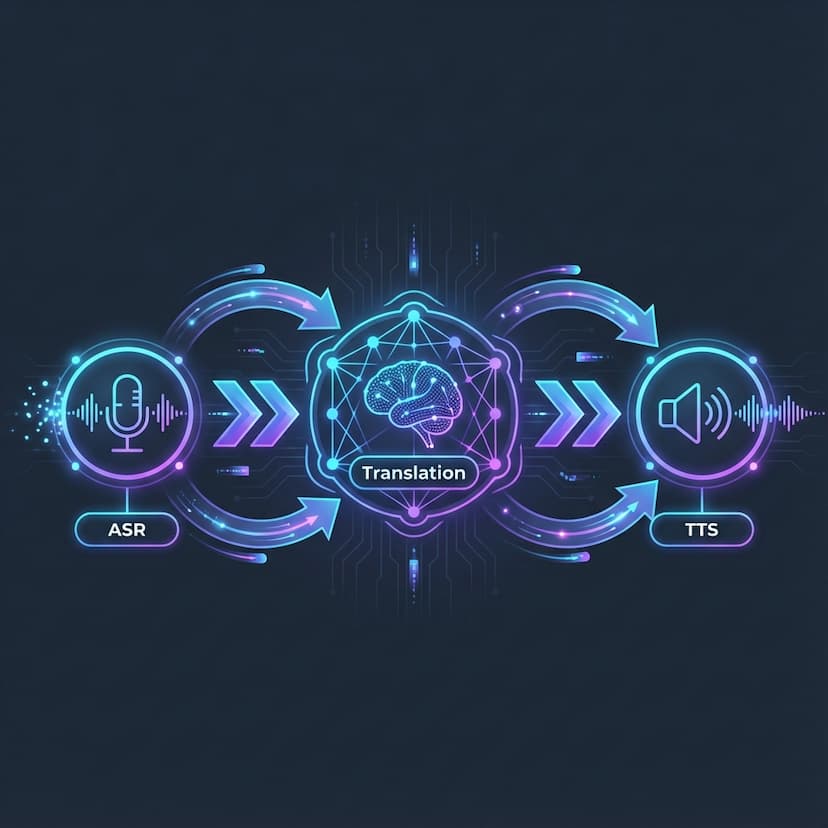
Every real-time speech translation system, regardless of vendor or application, relies on three core stages working in rapid sequence: Automatic Speech Recognition (ASR), Neural Machine Translation (NMT), and Text-to-Speech synthesis (TTS). The total latency experienced by the end user is the sum of latency at each stage, plus any network transmission delays. Optimizing the full system requires attacking all three stages simultaneously.

Streaming ASR: Transcribing Before the Sentence Ends

Traditional ASR systems waited for a pause or sentence boundary before processing audio — a design that made sense when transcription was the end goal but introduces unacceptable delays for real-time translation. Modern streaming ASR systems use a different approach: they emit partial transcription hypotheses continuously as audio arrives, updating and revising those hypotheses with each new audio frame.

The core architecture is typically a recurrent or transformer-based acoustic model paired with a language model that scores hypothesis sequences. Systems like Google's Streaming RNN-T and Meta's SeamlessStreaming use end-to-end trained models that directly output token probabilities from raw audio, eliminating the latency of intermediate feature extraction stages. State-of-the-art streaming ASR can emit word-level hypotheses with less than 200ms of audio delay on standard hardware.

Neural Machine Translation in Real Time

The translation stage presents a fundamental tension: NMT models perform best when they can see a complete sentence before translating, because meaning often depends on words that appear later in the sentence. But waiting for sentence boundaries adds latency. Real-time systems resolve this through several techniques.

Simultaneous translation policies, such as the "wait-k" policy, define rules for when the system should translate based on partial input versus wait for more context. More recent approaches use reinforcement learning to train the system to make wait/translate decisions dynamically, learning from human simultaneous interpreters who have developed their own heuristics for handling this exact problem over decades of practice.

Incremental NMT outputs "committed" tokens — words it is confident will not be revised — separately from "tentative" tokens that may change as more source audio arrives. This distinction matters for the downstream TTS stage: you want to begin synthesizing committed tokens immediately while buffering tentative ones.

Incremental TTS: Speaking Before the Translation Is Complete

The TTS stage faces the same incremental challenge as ASR and NMT: how do you produce natural-sounding speech when you don't yet have the full sentence? Prosody — the melody and rhythm of speech — in most languages requires sentence-level context. A statement ends with falling pitch; a question ends with rising pitch. If you commit to the wrong prosody early, the output sounds unnatural.

Current solutions use a combination of predictive prosody modeling (estimating likely sentence-final prosody from the words seen so far) and re-synthesis buffering (holding short segments in a buffer and resynthesizing with corrected prosody when later words confirm the sentence structure). The result is speech that sounds slightly more measured than natural conversation but remains intelligible and natural-sounding to most listeners.

Latency: The Critical Metric and Current Benchmarks

End-to-end latency for real-time speech translation is typically measured as the delay between when a speaker completes a sentence and when the listener hears the translated version. As of early 2026, best-in-class systems achieve 1.5 to 3 seconds of end-to-end latency for common language pairs like English-Spanish or English-French. For more distant language pairs with different word orders (English-Japanese, English-Arabic), latency increases to 3-5 seconds due to the need for more source context before translation can begin.

Perceived latency is as important as actual latency. Systems that produce continuous audio output — even if slightly behind — feel more responsive than systems that produce nothing and then deliver a burst of translated speech. Streaming output, even at slightly higher total latency, dramatically improves the user experience.

Current State of the Art: Google, Meta SeamlessM4T, and VoiceOver Speech

Google's real-time translation capabilities, deployed across Google Meet and Google Interpreter Mode, use a proprietary streaming pipeline with hardware-accelerated inference on custom TPUs. The system supports over 40 language pairs and includes adaptive noise cancellation tuned for the translation pipeline.

Meta's SeamlessM4T, released as an open-weight model, represents a significant architectural advance: a single unified model that handles ASR, NMT, and TTS together rather than three separate models. This end-to-end approach reduces the error accumulation that occurs when mistakes in ASR compound with mistranslations in NMT. SeamlessM4T covers 100 input languages and 35 output languages, with a streaming variant called SeamlessStreaming optimized for real-time use.

Newer entrants like VoiceOver Speech have focused on voice-preserving translation — maintaining not just the content but the speaker's acoustic characteristics in the output. This is particularly valuable for use cases like live dubbing of keynote speeches or international press conferences, where the speaker's identity and emotional register are part of the communication.

The On-Device Processing Revolution

The next major inflection point for real-time translation is the shift from cloud to on-device processing. Current high-quality systems require server-side inference, introducing network latency and creating privacy concerns for sensitive conversations. But neural network compression techniques — quantization, pruning, knowledge distillation — have reduced model sizes dramatically.

Apple's on-device translation (built into iOS and macOS) already handles text translation entirely locally. The challenge is real-time speech translation, which requires larger models for acoustic processing. Several research groups have demonstrated real-time speech translation on mobile hardware at 4-bit quantization, with quality approaching cloud models for common language pairs. By 2027, high-quality on-device real-time translation for major language pairs is a realistic expectation.

Future Directions: Beyond Language to Intent

The next frontier in real-time translation is not just faster or more accurate language conversion, but deeper understanding of communicative intent. Current systems translate what was said; future systems will be designed to translate what was meant — accounting for cultural pragmatics, register differences, and context-dependent implicature.

Research systems are beginning to incorporate cultural adaptation layers that, for example, transform an indirect Japanese refusal into its direct English equivalent, or add appropriate formality markers when translating into Korean or Japanese. These adaptations require models that understand not just syntax and semantics but social and cultural context.

Multimodal translation — combining audio with visual information like gestures, facial expressions, and lip movements — is another active research direction. In noisy environments or for speakers with accents underrepresented in training data, visual information can significantly improve ASR accuracy and therefore translation quality.

Want to experience state-of-the-art speech translation technology firsthand? Try it on the dashboard and see how modern AI handles real-time voice conversion across languages.

Technology

Real-Time Speech Translation: How It Works and Where It's Heading

2026-02-19
12 min

Real-time speech translation — the ability to hear someone speak in one language and receive spoken output in another within seconds — was science fiction a decade ago. Today it powers live international broadcasts, simultaneous conference interpretation, and cross-language customer service at scale. Understanding how the technology actually works reveals both why it has improved so dramatically and what barriers remain on the path to truly seamless human-to-human communication across languages.

The Three-Stage Pipeline

ADVERTISEMENT

Every real-time speech translation system, regardless of vendor or application, relies on three core stages working in rapid sequence: Automatic Speech Recognition (ASR), Neural Machine Translation (NMT), and Text-to-Speech synthesis (TTS). The total latency experienced by the end user is the sum of latency at each stage, plus any network transmission delays. Optimizing the full system requires attacking all three stages simultaneously.

Streaming ASR: Transcribing Before the Sentence Ends

Traditional ASR systems waited for a pause or sentence boundary before processing audio — a design that made sense when transcription was the end goal but introduces unacceptable delays for real-time translation. Modern streaming ASR systems use a different approach: they emit partial transcription hypotheses continuously as audio arrives, updating and revising those hypotheses with each new audio frame.

The core architecture is typically a recurrent or transformer-based acoustic model paired with a language model that scores hypothesis sequences. Systems like Google's Streaming RNN-T and Meta's SeamlessStreaming use end-to-end trained models that directly output token probabilities from raw audio, eliminating the latency of intermediate feature extraction stages. State-of-the-art streaming ASR can emit word-level hypotheses with less than 200ms of audio delay on standard hardware.

Neural Machine Translation in Real Time

The translation stage presents a fundamental tension: NMT models perform best when they can see a complete sentence before translating, because meaning often depends on words that appear later in the sentence. But waiting for sentence boundaries adds latency. Real-time systems resolve this through several techniques.

Simultaneous translation policies, such as the "wait-k" policy, define rules for when the system should translate based on partial input versus wait for more context. More recent approaches use reinforcement learning to train the system to make wait/translate decisions dynamically, learning from human simultaneous interpreters who have developed their own heuristics for handling this exact problem over decades of practice.

Incremental NMT outputs "committed" tokens — words it is confident will not be revised — separately from "tentative" tokens that may change as more source audio arrives. This distinction matters for the downstream TTS stage: you want to begin synthesizing committed tokens immediately while buffering tentative ones.

Incremental TTS: Speaking Before the Translation Is Complete

The TTS stage faces the same incremental challenge as ASR and NMT: how do you produce natural-sounding speech when you don't yet have the full sentence? Prosody — the melody and rhythm of speech — in most languages requires sentence-level context. A statement ends with falling pitch; a question ends with rising pitch. If you commit to the wrong prosody early, the output sounds unnatural.

Current solutions use a combination of predictive prosody modeling (estimating likely sentence-final prosody from the words seen so far) and re-synthesis buffering (holding short segments in a buffer and resynthesizing with corrected prosody when later words confirm the sentence structure). The result is speech that sounds slightly more measured than natural conversation but remains intelligible and natural-sounding to most listeners.

Latency: The Critical Metric and Current Benchmarks

End-to-end latency for real-time speech translation is typically measured as the delay between when a speaker completes a sentence and when the listener hears the translated version. As of early 2026, best-in-class systems achieve 1.5 to 3 seconds of end-to-end latency for common language pairs like English-Spanish or English-French. For more distant language pairs with different word orders (English-Japanese, English-Arabic), latency increases to 3-5 seconds due to the need for more source context before translation can begin.

ADVERTISEMENT

Perceived latency is as important as actual latency. Systems that produce continuous audio output — even if slightly behind — feel more responsive than systems that produce nothing and then deliver a burst of translated speech. Streaming output, even at slightly higher total latency, dramatically improves the user experience.

Current State of the Art: Google, Meta SeamlessM4T, and VoiceOver Speech

Google's real-time translation capabilities, deployed across Google Meet and Google Interpreter Mode, use a proprietary streaming pipeline with hardware-accelerated inference on custom TPUs. The system supports over 40 language pairs and includes adaptive noise cancellation tuned for the translation pipeline.

Meta's SeamlessM4T, released as an open-weight model, represents a significant architectural advance: a single unified model that handles ASR, NMT, and TTS together rather than three separate models. This end-to-end approach reduces the error accumulation that occurs when mistakes in ASR compound with mistranslations in NMT. SeamlessM4T covers 100 input languages and 35 output languages, with a streaming variant called SeamlessStreaming optimized for real-time use.

Newer entrants like VoiceOver Speech have focused on voice-preserving translation — maintaining not just the content but the speaker's acoustic characteristics in the output. This is particularly valuable for use cases like live dubbing of keynote speeches or international press conferences, where the speaker's identity and emotional register are part of the communication.

The On-Device Processing Revolution

The next major inflection point for real-time translation is the shift from cloud to on-device processing. Current high-quality systems require server-side inference, introducing network latency and creating privacy concerns for sensitive conversations. But neural network compression techniques — quantization, pruning, knowledge distillation — have reduced model sizes dramatically.

Apple's on-device translation (built into iOS and macOS) already handles text translation entirely locally. The challenge is real-time speech translation, which requires larger models for acoustic processing. Several research groups have demonstrated real-time speech translation on mobile hardware at 4-bit quantization, with quality approaching cloud models for common language pairs. By 2027, high-quality on-device real-time translation for major language pairs is a realistic expectation.

Future Directions: Beyond Language to Intent

The next frontier in real-time translation is not just faster or more accurate language conversion, but deeper understanding of communicative intent. Current systems translate what was said; future systems will be designed to translate what was meant — accounting for cultural pragmatics, register differences, and context-dependent implicature.

Research systems are beginning to incorporate cultural adaptation layers that, for example, transform an indirect Japanese refusal into its direct English equivalent, or add appropriate formality markers when translating into Korean or Japanese. These adaptations require models that understand not just syntax and semantics but social and cultural context.

Multimodal translation — combining audio with visual information like gestures, facial expressions, and lip movements — is another active research direction. In noisy environments or for speakers with accents underrepresented in training data, visual information can significantly improve ASR accuracy and therefore translation quality.

Want to experience state-of-the-art speech translation technology firsthand? [Try it on the dashboard](/dashboard) and see how modern AI handles real-time voice conversion across languages.
Ready to Experience Sonic Voice Translation?

Try VoiceOver Speech today and experience AI speech translation that preserves your original voice.

Get Started

Related Articles